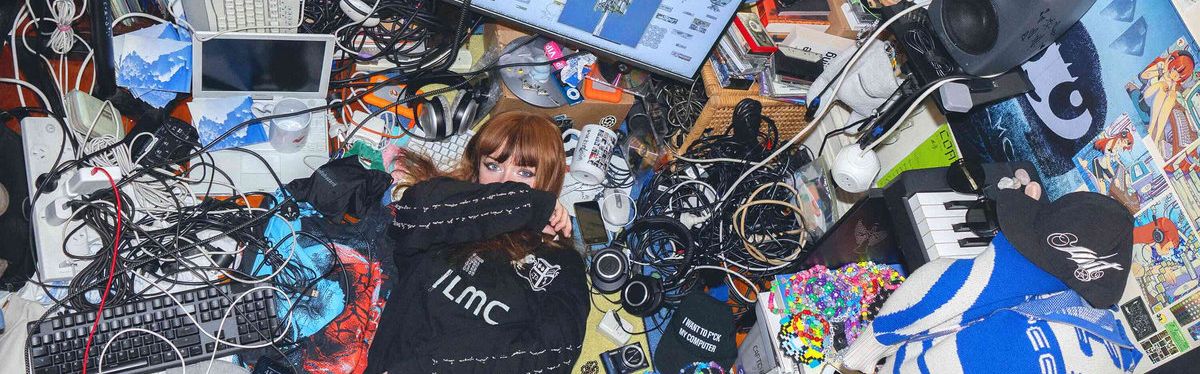
Ninajirachi‘s 2025 debut album is a scintillating dance pop love letter to a new otaku generation.
first impressions
What is I Love My Computer?
It’s a transhumanist manifesto.
It’s plugging into college ethernet in the summer of 2003, downloading all the anime, manga, and doujinshi you can find, and rewiring your brain with denpa — Momoi Haruko, Under17, Shinohara Tomoe, Kotoko.
It’s coming of age on the early internet, discovering a portal onto a wild, limitless canvas where anyone can upload and download unfiltered ideas, merging directly, sometimes dangerously, with the minds of others.
It’s transitioning from confinement in one particular nexus of space-time, inside your own head, to a consciousness mediated by the speed of a search query or a file download, limited only by the sum of human knowledge.
It’s exalting in the revolutionary creative potential of the man-machine interface, in the dance among the digital stars without number.
It’s Romance with the computer, with a capital R.
It’s Glitch Feminism.
(There is something irreducible, new, and real about the embrace of online possibilities for identity, but to reach their maximum potential, they need to loop back into the fabric of reality. Through seeing and being seen as a whole; our matter craves form, and our matter requires space, and space is political)
It’s a sublime fusion of all of these into a celebration of the best of what we are-as-becoming.
It’s permission to be a freak on the internet again.
Once in awhile an album comes along and refuses to let go.
This is that album.
second impressions
The tracks flow from one to another like a produced DJ set, with some breaks, able to be enjoyed in isolation but best to be fully immersed in as a whole.
London Song
It starts with a grungy, glitchy proposition: I’ve never been to London, but I’d go with you. Nina launch us into the virtual world of the computer, where the music becomes fully realized and actualized; “anything is possible with fingers, eyes, a mouse, and a screen”; then
iPod Touch
Checks back in with Nina’s hardware and software origins in a catchy, poppy, nostalgic dance track;
Fuck My Computer
And on to the provocatively titled Fuck My Computer, which is a full essay topic on its own. The ways that we:
- Develop close personal relationships with our tools, as workers
- Fetishize gear and equipment, as hobbyists
- Develop attachments to the experiences specifically enabled by modern computing, both creative and connective, and the amorous / romantic / emotional attachment to the object, in absence (or presence) of another physical embodiment of those connections
- The ways in which these strong emotions are inverted, in the present moment, into hatred of what our computers have become: prisons, enclosures, walled gardens of extraction and exploitation, preying on the purity of the promise they offered when we were young — the promise of freedom, creativity, and connection, now subverted
- See: Kill The Computer; Better Offline; and Ed Zitron’s Never Forgive Them
- The feelings of betrayal and fatigue at having to exist in an oppositional, antagonistic relationship with the computer in the present day
- The longing for a return to the computer as a tool designed only with the user in mind, a return to the intimacy of that connection that could be crafted through personal configuration of the physical and digital operating environment, now so insidiously infested with tendrils of surveillance and antagonistic, unwanted, system behaviors (AI….)
- The double reading, as subtext, of “no, seriously, FUCK MY COMPUTER” — though this doesn’t really, scan, as the possessive “my” implies intimacy in the way that “kill the computer” doesn’t. There’s a mourning, here, for me, entirely in my head and not in the track.
- Nina doesn’t go there (here), instead she truly dwells in that space of thanking the robot — appreciating the computer for what it has given her — and in a way that taps into so much of how I feel about technology. “I wanna thank you” from Mr. Roboto feels a whole lot like “I wanna fuck you”, in this context
- And remember: you can’t thank AI in a way that matters, and that’s insidious
- Nina doesn’t go there (here), instead she truly dwells in that space of thanking the robot — appreciating the computer for what it has given her — and in a way that taps into so much of how I feel about technology. “I wanna thank you” from Mr. Roboto feels a whole lot like “I wanna fuck you”, in this context
- The Computer was supposed to be the avatar of (liberal, democratic, capitalist) progress for our generation, and it’s turned into just another offshore oil platform
CSIRAC
- Named after the first computer in the world to play digital music
- Commonwealth Scientific and Industrial Research Automatic Computer
- Australia’s first digital computer, https://en.wikipedia.org/wiki/CSIRAC
- Almost unintelligibly hyper chippy, glitchy, pop-dance-techno, feels like a manic caffeinated scrolling session
- “You are the girl, the one I want” on infinite loop in the lyrics — is she speaking to me?
- Sinking deeper into the lyrics, finding an almost delirious sapphic fantasy
Delete
- Another smooth segue, this time into the first genuinely anthemic paean of the album
- A bit uptempo for an EDM anthem, tethering it back into a soaring pop bop
- This one an homage to a crush over the wires, over social media, a regretted post, a revealing selfie
- The spoken vocal refrain: Modern, mega, digital, meta, matin’ ritual
ฅ^•ﻌ•^ฅ
- First real gap between songs
- Starts with a surprisingly melancholy analog guitar riff, before pivoting and building up into a more major key
- The beat kicks in and we’re back in familiar peppy dance territory for the back half of this very short track
All I Am
- Before we know it, a smooth transition into All I Am, that builds into…
- A minimalist, hard-driving dance number, stripped down to synth lead, repetitive vocals, and a quick beat
- Before pivoting in the middle into a new vocal motif, and then a new synth pattern, dropping the beat out, and building up back to full potency
- One of the most straightforward dance-y tracks on the album, subverted at the very end by a sudden key change
Infohazard
- No real segue into this, just a clean start, with quick reverb synth hits and sparkly echo on high piano notes
- The soundscape clears for a tragic lyric of unavoided online trauma, paired with the typical uptempo beat, and a more melancholy chord progression, dealing with the dross of the crowded online Bo-Burnham-Internet
- Then building half way through into a harder dance groove, continuing to build to yet another peak and plateau for a fully saturated sonic spectrum for the final minute and a half of the track
Battery Death
- Coming out of Infohazard, a thesis: we took it too far. Another stop and start, no segue
- (Ego) Death in the Internet
- We took it too far // couldn’t stop it // how we got so far from where we started // we took it too far // still I want it // running right back, arms wide, open-hearted
- We took the internet, and computers, too far — and yet we still exist, and want to exist, in a love/hate relationship with them
- the closest to dubstep that the album gets
- Ending with a hard dissolution into the melodic vocal line, and then a sudden shift into a downtempo lyrical vocal, that fuzzes and fades out, to make way for
Sing Good
- Regrounds back into the simple bliss of an intimate, personal artist’s statement and invocation of friendship:
- I sit out on the balcony with my oldest friend // The spirit in the room with me that carries my pen
- That’s it, isn’t it? That’s the Meaning
- A simple vocal track, lightly effected, with a gated synth accompaniment and no rhythm other than the pulse of the synth that gradually swells over the song’s runtime
- Before receding to reveal the clean, simple vocal again
It’s You
- Nina regroups for one final pop dance anthem, with Vocaloid-style embellishments and an unrelenting drive, just pure fun
All At Once
All At Once dives back into the digital oceanic abyss, with industrial strength, taking us on a tour back through the entire album, and feels like Nina’s showing off at this point — pure virtuosic production, emerging from the abyss to the plane of the real, bathed in synthetic vocal samples, moving into a syncopated yet eminently danceable groove, before dissolving into 8-bit static, and finally emerging into the lead vocal
Taking off into the stratosphere as the vocals coalesce through the noise into a chanting triumphant return to the anthemic styles that have threaded through the entire album, and ending with a solid minute of warbly, chippy a e s t h e t i c beats, returning to the voice synth, and ending almost with a Vangelis-esque detuned melodic line, before fading into nothing
final impressions
Full body shivers. She cracked the code; the through line between what we were looking for, and what we found, and what we missed, and what we lost.
Nina sums it up in her interview with Apple Music for the album, regarding its final track:
All at Once: The verse at the end is about, I’m always at my desk in the dark, always working by myself late at night at the computer—that’s where I get the best work done a lot of the time. I wanted to send off the album with the last devotional nod to everything my computer had done for me, good and bad. It’s allowed me to have this crazy career that I wouldn’t have been allowed to have if I didn’t grow up in this decade. It would have been totally different.
Human-computer interaction, and computer-mediated human interaction, has changed us. For good and bad. It has allowed us to see one another, and to see more of humanity, than ever before, in a way that is impossible to conceive the profundity of. The digital commons was a place of marvel and danger and love and hate and crazy experiments; and now we ALL (all of humanity!) live there, and we need to figure out how to do so harmoniously.
But back when we were young, we were there, on the infinite frontier, sometimes falling off the edges, sometimes flying, sometimes forming radical new and recombinant formations of our shared humanity based on the impulses encoded in our DNA and our needs for one another, needs that had been so atomized by the imperatives binding our physical meatspace realities that we had no idea — I had no idea — how to relate in a totally unbounded space.
Since then we’ve been figuring out, however imperfectly; and I Love My Computer is a testament to how far we’ve come.
Featured image from the album art