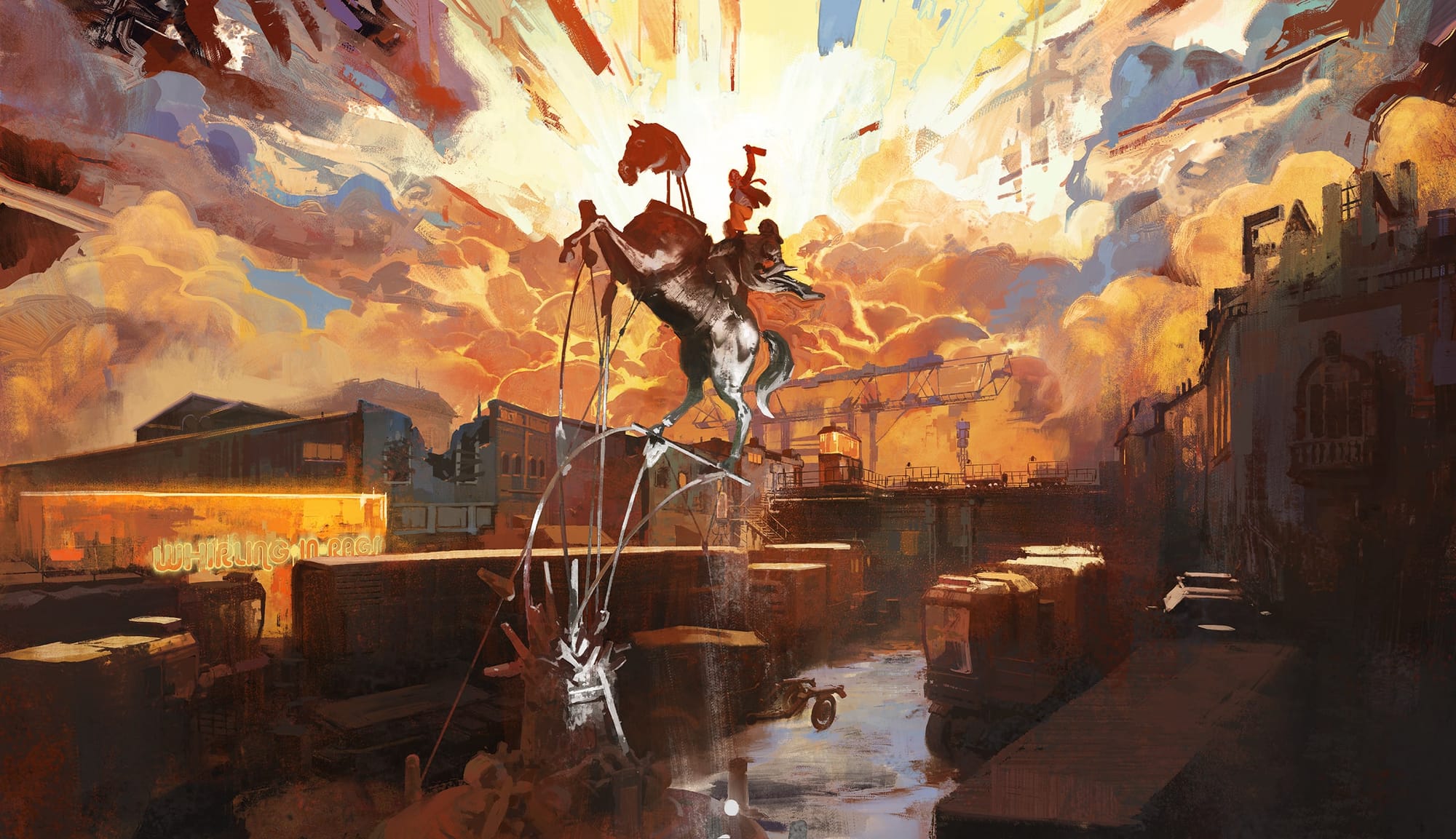
This post contains spoilers for the 2019 video game Disco Elysium.
And we drink / ever notice how drinking’s like war / cup o’ troops o’er the gums / to the end of our health, a campaign ‘gainst myself / armed with bourbons and scotches and rums
— Moxy Früvous, The Drinking Song
It was the spring of 2003, and two days before graduating from college I decided to try hard alcohol. I’d tried cider and beer before, but wasn’t much of a drinker; this would be my first foray into the hard stuff, and I wanted to make it count.
I logged onto the Something Awful forums in search of advice. With a helpful overview from some fellow goons I decided on the following lineup:
- Gin and tonic
- Rum and coke
- Bushmills whiskey
- Jägermeister
I hit up the off campus liquor store and brought the haul back to the Japan house dorm. I took pictures for the forum thread and got started.
I discovered that of the four the Bushmills was my favorite, and passed the next several hours in pleasant stages of inebriation in the company of my fellow forum-goers. About two thirds through the Bushmills, the experiment ended and I went to bed.
I woke up at 3:30 AM, staggered to the bathroom, and mostly made it to the toilet before my insides were outside.
Two days later I walked across the graduation stage, still hung over, and received an empty diploma case. I had too many incompletes; it wouldn’t be until the end of the summer that I actually graduated.
I had to have the diploma mailed to me, since by that time I’d already started teaching English in Japan.
Disco Elysium is a game about violence.
It’s about the violence that a man does to himself, to his friends, to strangers, to his lover, to society.
It’s about the violence that they do to him.
It’s about the violence of systems. It’s about the sparks that fly when they clash, and the damage that comes when people with guns get ideas bigger than they are.
It’s about imperialism, and capitalism, and nihilism, and sexism, and racism.
It’s about the end of the world.
It’s about getting fucking wasted, and what happens after.
Hungover
In Disco Elysium you take the role of an amnesiac police detective. We’ll call him Harry.
As Harry you’re tasked with two primary objectives: solving the murder of a mercenary caught between two sides of a trade union dispute, and reconstructing your shattered psyche in the aftermath of an apocalyptic bender.
You take the role of a mech pilot sitting inside Harry’s head, tugging at the levers of his conflicting impulses as you try to pull together the facts of what happened in the lead up to a morning of dull, aching sobriety.
Harry’s a real piece of work, it turns out. Somewhere on the far side of middle age, strung out on all the pills and booze he can find, stewing in a compounded mess of his own making that you’ll sift through to see if there’s anything left to save.
The fact that this man could do anything but lay down and die after the amount of abuse he’s endured is nothing short of a miracle.
And yet, here you both are.
Being Harry
This question echoes over the course of the game: why are you here? Why does Harry get a second chance, when so many others don’t? After committing sin upon sin, why is Harry allowed to persist?
As you roam the town asking intrusive questions and scrounging in trash cans, looking for clues and pieces of Harry’s past, a pattern starts to emerge.
Harry’s not alive through luck, though he has better fortune than most. He’s squandered every seeming advantage he has, coasted on raw skill well past the breaking point, deliberately tempting fate many times over.
No, the game tells us; this one’s no mystery. It turns out you can fuck yourself to oblivion and still come back from the brink, as long as you’re wearing a badge.
With the law by his side, Harry’s bizarre behavior is explained away as the madness of an idiot savant. “A genius works in strange ways,” people say, as you turn over their dressers looking for loose change.
The privilege of Harry’s office saved his life, and is in passive effect every second of the game. The freedom he enjoys as an erratic, possibly insane detective is built on the reputation of his office, and the implicit threat of state-sanctioned violence that lurks behind it. And you, as the player, get to live with unsettling feeling of inhabiting a walking ACAB poster child.
Inherent in the system
The amnesia of a bad hangover does more than just make Harry an ignorant audience proxy, or a blank slate for you to customize. Instead, the game prompts you with some far more fundamental questions.
“What is money, anyway?” Harry can ask, upon learning that he’s deep in debt for trashing the hotel that’s the site of his most recent transgressions. The answer is grim; the game’s economy is viscerally meager, and only becomes less so if you’re willing to abuse Harry’s status to shake people down.
If you don’t abuse that power, the first few in-game days become dominated by the constant need to find enough money to afford a place to sleep. You’ll have to scrounge for bottles to recycle if you want to buy anything, and to get debt-free, you’ll have to sell Harry higher up the local food chain.
The real devil of it all is that the bosses make a pretty good case for themselves. The smart, savvy, impeccably liberal corporate rep; the pragmatic, conniving, deal-making union boss. Both persuasive advocates for their positions; both exploiting the corruption and violence of their ideologies.
Which master will Harry choose, and how loyal will he be? You have some time to think, but as in life, time in Harry’s head is the ultimate limited resource.
Slowing down
Time in Disco Elysium a funny thing.
A conceit of the game is that time on the in-game clock isn’t measured by space; it’s measured by interaction. You can walk across the map without a second passing; you can stop anywhere safely and just be without worrying that you’ll miss something.
Conversely, interacting with the world inexorably moves the clock forward. Every moment spent with others is precious, ephemeral, representative of a choice made and a path deliberately taken.
The game knows this, and is forgiving; failure is soft and inevitable, and flows forward in a cadence alongside success that invites you to experience it without reloading.
Like a drug, Disco Elysium extends an invitation: a doorway to another frame of reference, another possibility space. A slower reality, where actions and their consequences occur in sequence and must be processed in real time, not overlaid in a frantic cascade of synaptic sensation.
The cleverness is that both you the player — and Harry the avatar — can experience this, depending on your choices: you can dive back into hedonic overload with every substance you find, or choose the path of sobriety, and start facing the consequences.
Whispers
As it progresses, the story of Disco Elysium invites you to loosen. To unclench the tight knot of feelings in your core, feelings that you can’t articulate but have metastasized over time under an onslaught of new information. Just slow down. Take things one by one. Process. Feel. Let it out.
In this, the game feels present, intentional.
Harry can’t save the world. He can’t offer others more than a reprieve from their suffering. He can’t, arguably, save himself.
Violence defines his relations in stark, sober ways. But you can choose how to orient him within it.
He can’t bring revolution alone; no one can. He can’t bring salvation.
He’s not ready to love. Not yet.
But you can start planting the seeds.
The end
The story of Disco Elysium contains only a handful of physical conflicts, yet it might be the most violent video game I’ve ever played.
The violence is enacted at intimate scale as Harry confronts his own demons, bargaining with his body and brain, finally forced to reckon with the damage he’s done to himself through years of self-harm.
The violence is emotional, in lies and love and betrayal, raw wounds left from the roughly-textured interactions of imperfect lives.
The violence is everyday, inescapable, systemic: a fly struggling in a web of poverty, patriarchy, hierarchy, supremacy.
Racial violence; class-based violence; gendered violence. Implicit and explicit biases, hatreds and fears, power imbalances and struggles of ideological and material control.
All set against the backdrop of a war-scarred city where life defiantly survives.
All at a slow, deliberate pace that confronts you and asks you to choose every step of the way.
The violence of age; the violence of time.
The conflict of a man against himself in a flawed world.
And yet a world where hope springs through the cracks; where a vision for a better world is possible.
And where urgent mysteries threaten to make everything — the whole scope and scale of history — completely trivial in the face of the end.
So yeah, that’s Disco Elysium.
You should probably play it, if you haven’t yet.
This review was originally posted here on 2/9/2023. This slightly edited version was reposted on 12/13/2025, recreated from the archive.org archives.